Supa-Trade.net Review: What Due Diligence Shows
Executive Summary
From a compliance and investor-protection perspective, Supa-Trade.net raises a number of concerns that warrant enhanced due diligence before any investor deposits funds or shares personal information. While the existence of a website alone does not prove misconduct, several transparency, ownership, regulatory, and governance issues create a risk profile that sophisticated investors should not ignore.
In financial services, trust is not established through marketing claims, trading dashboards, or promises of returns. Trust is established through regulatory authorization, transparent ownership structures, verifiable corporate disclosures, audited operations, and effective investor safeguards. Based on publicly available information reviewed during this assessment, Supa-Trade.net appears to provide limited evidence in these critical areas. Investors should therefore proceed with extreme caution.
Ownership Transparency Concerns
One of the most important elements of financial due diligence is identifying who owns and operates a platform. Legitimate investment firms typically disclose corporate ownership, executive leadership, physical business addresses, registration details, and regulatory status.
In the case of Supa-Trade.net, ownership transparency appears limited. Publicly available information provides little clarity regarding the individuals or legal entities ultimately responsible for the operation of the platform. This lack of transparency creates a significant challenge for investors attempting to verify accountability.
When investors cannot independently confirm who controls a platform, it becomes difficult to assess management experience, regulatory history, financial stability, or potential conflicts of interest. The inability to identify responsible parties also complicates dispute resolution should issues arise.
From a compliance perspective, opacity regarding ownership is a material risk factor because investors may have limited recourse if funds become inaccessible or if the platform ceases operations.
Regulatory Oversight and Licensing
Regulatory authorization is one of the strongest indicators that an investment platform is subject to minimum operational standards and ongoing supervision.
Investors evaluating any online trading platform should expect to see clear disclosure of licensing information, registration numbers, regulatory jurisdictions, and links to official regulator databases. These details should be independently verifiable.
Based on available information, Supa-Trade.net does not appear to provide the level of regulatory transparency typically expected from established financial institutions. The absence of clearly verifiable regulatory credentials should be viewed as a significant warning sign until proven otherwise.
A regulated entity is generally required to maintain compliance frameworks relating to anti-money laundering controls, client asset protection, financial reporting, complaint handling, and operational governance. Without independently verified regulatory oversight, investors have limited assurance that such controls exist.
The burden of proof should remain with the platform. Investors should not assume regulatory compliance simply because a website offers trading services or displays professional branding.
Domain and Operational Risk Indicators
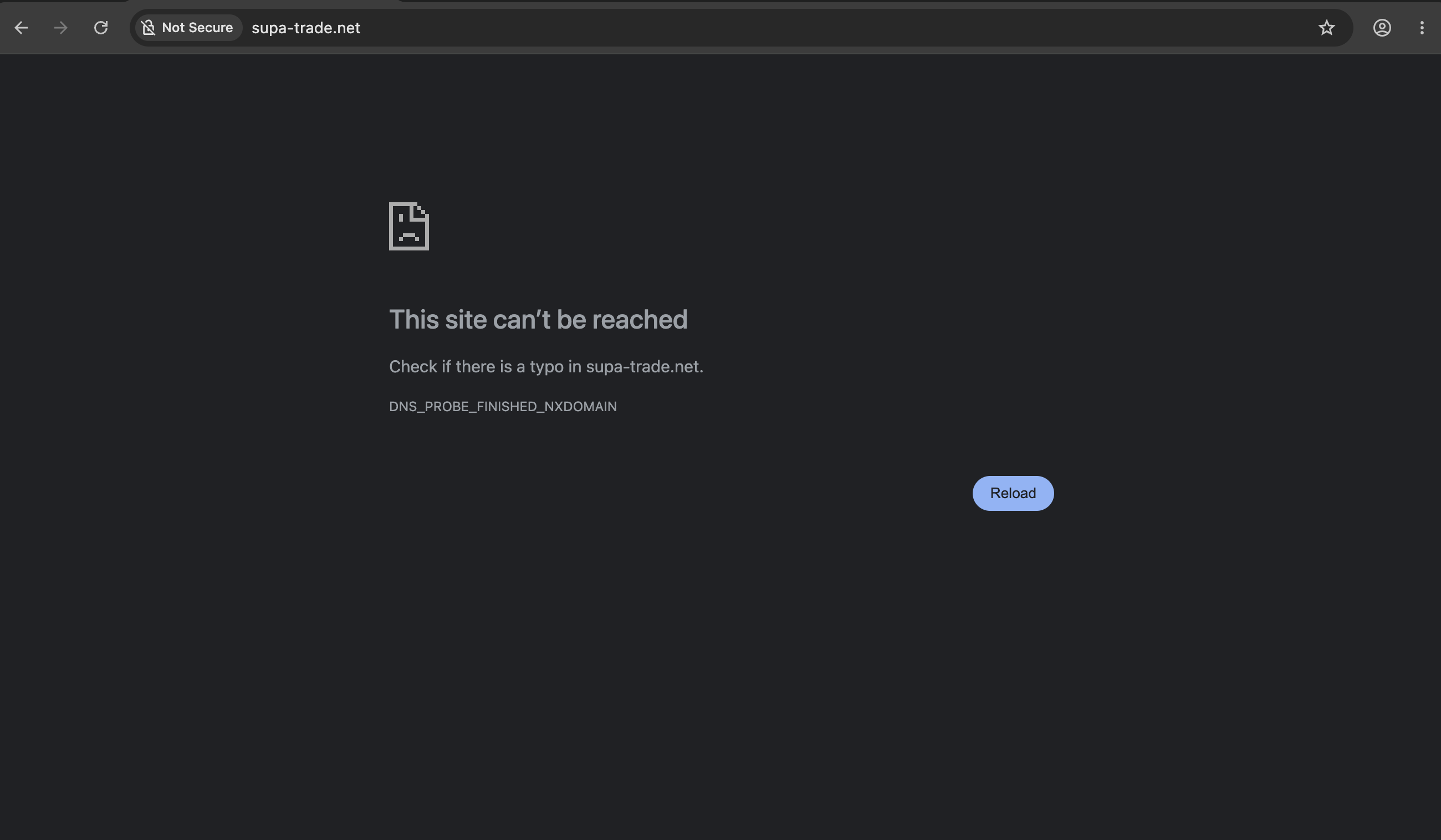
Website age and operational history are important components of due diligence. Public domain records indicate that Supa-Trade.net is a relatively new website, having been registered in January 2026. Newly registered financial websites should receive heightened scrutiny because they lack a long operating history and have not demonstrated resilience across market cycles.
Independent website-risk assessment services have also identified concerns regarding the domain. One review assigned the site a very low trust rating and highlighted multiple risk indicators associated with suspicious online activity.
Although risk-scoring services should not be treated as definitive evidence of fraud, they can serve as useful screening tools during the due diligence process. When multiple warning indicators exist simultaneously—including a new domain, limited transparency, and unclear regulatory status—investors should exercise caution.
Investor Protection Analysis
A key question for any investor is whether adequate safeguards exist to protect client assets.
Investor protection mechanisms commonly include:
- Segregation of client funds.
- Independent custodial arrangements.
- External audits.
- Compensation schemes.
- Regulatory dispute resolution procedures.
- Clear withdrawal policies.
- Formal complaint processes.
Publicly available information reviewed during this assessment provides limited evidence regarding these protections.
Without independently verified disclosures regarding custody arrangements and client asset segregation, investors may be unable to determine whether deposited funds are separated from operating capital. This distinction is critical because it directly affects investor recovery prospects if a platform experiences financial difficulties.
Similarly, there appears to be limited publicly available information regarding independent audits, financial reporting, or external oversight. The absence of these controls can increase operational risk and reduce transparency.
Trading Platform Considerations
The platform reportedly utilizes a web-based trading environment. However, investors should recognize that the appearance of a trading dashboard does not, by itself, validate the legitimacy of an investment operation.
Fraudulent investment schemes frequently employ sophisticated interfaces designed to simulate trading activity and account growth. Therefore, investors should focus less on visual presentation and more on verifiable evidence of execution, custody, regulation, and financial controls.
Independent analysis of a related trading subdomain identified additional risk indicators, including the site’s recent creation and concerns relating to the broader infrastructure supporting the platform.
These observations do not conclusively establish wrongdoing, but they do reinforce the need for enhanced due diligence.
Due Diligence Questions Investors Should Ask
Before depositing funds with Supa-Trade.net, investors should obtain clear answers to the following questions:
- What legal entity owns and operates the platform?
- In which jurisdiction is the company incorporated?
- Which financial regulator authorizes its activities?
- Can the regulatory authorization be independently verified?
- Where are client funds held?
- Are client assets segregated from company funds?
- Does the company undergo independent audits?
- Who are the directors and beneficial owners?
- What investor compensation mechanisms exist?
- What legal recourse is available in the event of a dispute?
Failure to obtain satisfactory answers to these questions should be treated as a significant risk factor.
Compliance Assessment
From a compliance analyst’s perspective, Supa-Trade.net exhibits several characteristics commonly associated with elevated-risk investment platforms:
- Limited ownership transparency.
- Limited publicly verifiable regulatory disclosures.
- Relatively recent domain registration.
- Insufficient evidence of robust investor-protection mechanisms.
- Limited independently verifiable operational history.
- Third-party risk assessments highlighting concerns.
While none of these factors individually proves fraudulent activity, their cumulative effect creates a risk profile that would generally justify enhanced due diligence and a conservative approach to investor engagement.
Conclusion
Based on the information currently available, Supa-Trade.net does not demonstrate the level of transparency, regulatory clarity, and investor-protection safeguards that many compliance professionals would expect from a trusted financial services provider.
Potential investors should approach the platform with caution, independently verify all claims, and avoid relying solely on website content or promotional materials. Until ownership structures, regulatory credentials, and investor safeguards can be clearly validated through independent sources, the platform should be regarded as a high-risk proposition from a due diligence standpoint.
The fundamental principle of investor protection remains simple: if a financial platform cannot clearly demonstrate who operates it, who regulates it, and how client funds are protected, investors should carefully consider whether the potential risks outweigh any promised opportunities.
-
Contact Bridgereclaim.com to Review Your Case
If you have lost money to supa-trade.net, it is important to act without delay. You can submit details of your experience to BRIDGERECLAIM.COM, a platform that assists individuals who have been affected by fraudulent online trading activity. Taking prompt action may improve the likelihood of addressing the situation and pursuing accountability for those responsible.
Unregulated brokers such as supa-trade.net continue to target unsuspecting investors. Staying informed, avoiding platforms that lack proper oversight, and alerting the appropriate channels can help protect both yourself and others from financial misconduct.