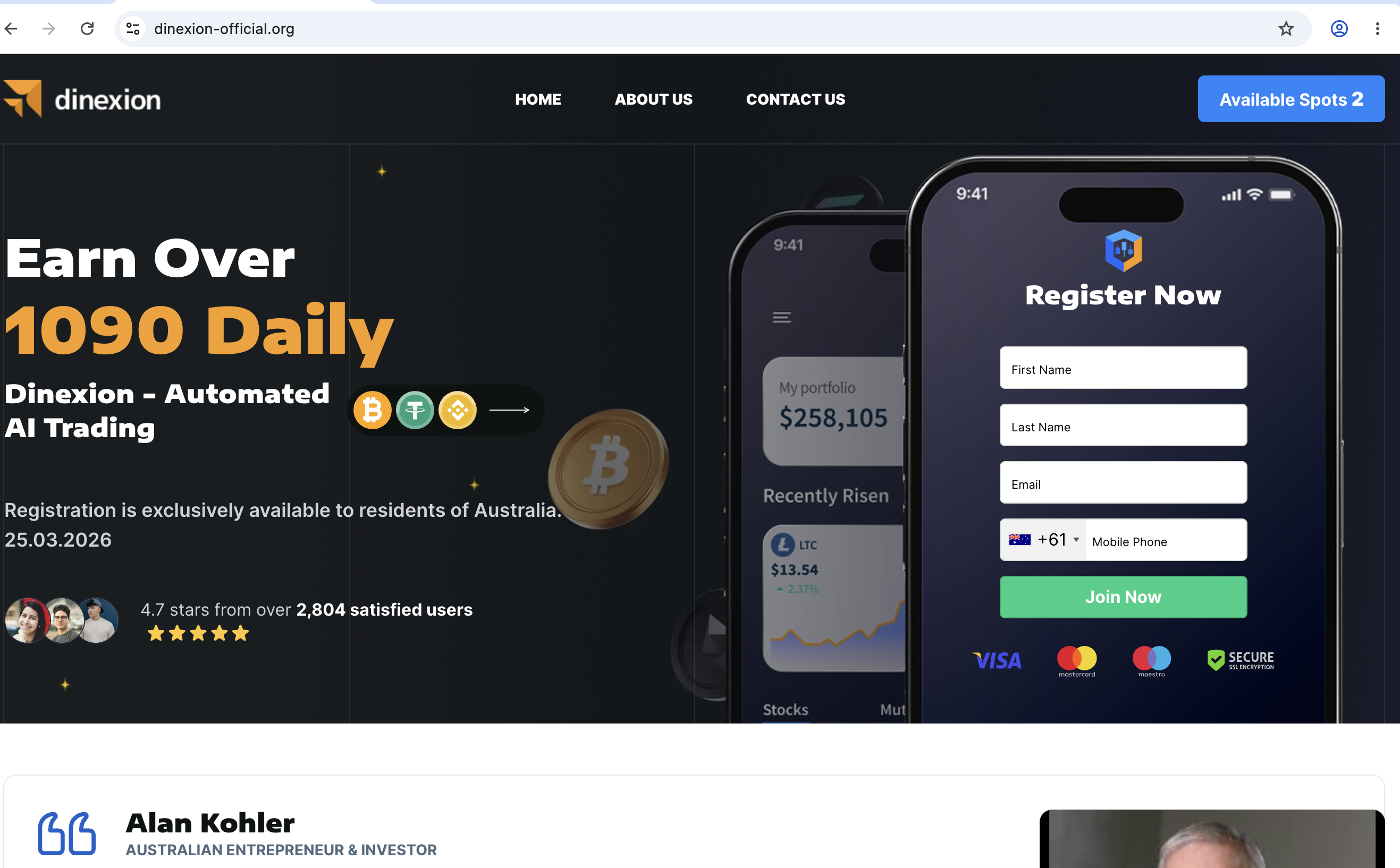
Dinexion Review: Due Diligence and Regulation Analysis
Executive Summary
This review evaluates Dinexion (dinexion-official.org) from the perspective of a compliance analyst conducting a due diligence assessment focused on transparency, regulatory status, ownership, governance, and investor protection. The platform presents itself as a provider of financial or investment-related services, yet publicly available evidence indicates that it operates without an identified financial services licence in the jurisdictions where it has attracted regulatory attention.
The most significant finding is that Dinexion has been publicly identified as an unlicensed or unregistered entity by regulatory alert systems. The Australian Securities and Investments Commission (ASIC), through the Moneysmart Investor Alert List, included Dinexion (dinexion-official.org) as “Unlicensed” on 17 April 2026. The IOSCO International Securities & Commodities Alerts Network (I-SCAN) also lists Dinexion as an “Unregistered/Unlicensed entity offering financial products or services”, reflecting concerns communicated through participating regulatory authorities.
Moneysmart.gov.au+1
Regulatory Status
Primary concern: absence of verified authorisation
For any platform offering investment products, contracts for difference, foreign exchange services, digital asset trading, portfolio management, or similar financial activities, the starting point of due diligence is verification of regulatory authorisation. In Dinexion’s case, the available evidence points in the opposite direction.
Regulatory finding
ASIC Moneysmart Investor Alert List
The alert list identifies “Dinexion (dinexion-official.org)” as “Unlicensed”, with the listing date recorded as 17/04/2026.
Moneysmart.gov.au
IOSCO I‑SCAN
The international alerts network describes Dinexion as an “Unregistered/Unlicensed entity offering financial products or services”.
iosco.org
These listings are not equivalent to a court finding or enforcement judgment, but they are material compliance signals. A prudent investor, institutional counterparty, or introducing broker would normally treat such alerts as requiring enhanced due diligence before establishing any relationship with the platform.
Moneysmart.gov.au+1
What is missing?
A review of the publicly available information does not identify a clearly disclosed licence number, supervising authority, or authorised legal entity associated with Dinexion. A regulated financial intermediary would ordinarily provide, at minimum:
-
The legal name of the operating company.
-
Registration number in the relevant corporate registry.
-
Financial services licence number.
-
Name of the supervising regulator.
-
Registered office address.
-
Client money and custody arrangements.
-
Complaints and dispute-resolution procedures.
The absence of these core disclosures materially weakens the platform’s transparency profile and makes independent verification difficult.
Ownership and Corporate Transparency
Limited visibility into beneficial ownership
Ownership transparency is a central element of financial due diligence. Investors need to know who ultimately controls the platform, which jurisdiction governs the operating entity, and whether directors or beneficial owners can be independently verified.
Publicly accessible WHOIS resources demonstrate that domain registration information can be queried through standard WHOIS or RDAP systems, but the available search results do not provide a verified beneficial ownership disclosure for Dinexion.
Who.is+1
Why this matters
In regulated financial markets, corporate transparency supports:
-
Assessment of conflicts of interest.
-
Verification of management experience.
-
Sanctions and anti-money-laundering screening.
-
Legal accountability in the event of disputes.
-
Evaluation of capital adequacy and governance.
Where a platform’s ownership structure cannot be readily established from public disclosures, counterparties typically classify the relationship as higher risk from a compliance perspective.
Governance and Operational Disclosure
Corporate governance indicators are difficult to verify
Well-governed financial firms usually publish information about directors, senior executives, risk committees, custody arrangements, and external auditors. Such disclosures allow independent assessment of operational resilience and oversight.
For Dinexion, publicly available information does not clearly identify:
-
Named directors or senior management.
-
External audit arrangements.
-
Client asset segregation policies.
-
Capital adequacy reporting.
-
Risk management framework.
-
Board or committee structure.
From a compliance analyst’s perspective, the absence of these disclosures does not prove misconduct, but it does create a significant information gap that prevents a meaningful assessment of governance quality.
Investor Protection Framework
Key safeguards appear unclear or undisclosed
Investor protection is strongest when a platform operates within a recognised regulatory framework that imposes conduct, capital, reporting, and custody requirements. Based on the available evidence, Dinexion does not present a clearly verifiable investor protection framework comparable to those typically required of licensed financial services providers.
Protections investors normally expect
-
Segregation of client money from company funds.
-
Participation in dispute-resolution or compensation schemes where applicable.
-
Periodic regulatory reporting.
-
Independent financial audits.
-
Clear terms governing withdrawals and custody.
-
Formal complaints handling procedures.
-
Ongoing regulatory supervision and enforcement oversight.
Publicly available information reviewed for this assessment does not clearly demonstrate that these protections are in place for Dinexion. The regulatory alerts referenced above further reinforce the need for caution when assessing the platform’s investor protection standards.
Moneysmart.gov.au+1
Due Diligence Assessment
Identity verification
-
Legal entity: not clearly disclosed in publicly available materials reviewed.
-
Registered office: not clearly verified.
-
Beneficial owners: not clearly identified.
-
Regulatory licence: no verified licence identified; platform appears on unlicensed or unregistered alert lists.
Moneysmart.gov.au+1
Operational transparency
-
Limited disclosure regarding custody and safeguarding arrangements.
-
Limited disclosure regarding external audit oversight.
-
Limited disclosure regarding financial reporting.
-
Limited disclosure regarding governance structure.
Regulatory profile
-
Appears on the ASIC Moneysmart Investor Alert List as “Unlicensed”.
Moneysmart.gov.au
-
Appears on the IOSCO I‑SCAN network as an “Unregistered/Unlicensed entity offering financial products or services”.
iosco.org
Comparative Transparency
Compared with a licensed broker or investment platform, Dinexion exhibits substantially lower public transparencyacross several dimensions:
|
Area |
Typical licensed provider |
Dinexion (publicly verified) |
|---|---|---|
|
Licence disclosure |
Usually prominent |
Not clearly verified |
|
Regulator identified |
Yes |
Not clearly identified |
|
Beneficial ownership |
Generally available |
Not clearly disclosed |
|
Audited financials |
Common |
Not publicly evident |
|
Client asset safeguards |
Usually documented |
Not clearly documented |
|
Regulatory alerts |
Normally absent |
Present Moneysmart.gov.au+1
|
Compliance Analyst Conclusion
From a compliance and due diligence perspective, Dinexion (dinexion-official.org) presents a high-transparency-risk profile. The decisive factor is not merely the absence of detailed corporate disclosures, but the fact that the platform has been publicly identified by ASIC’s Moneysmart Investor Alert List and the IOSCO I‑SCAN network as an unlicensed or unregistered entity offering financial products or services.
Moneysmart.gov.au+1
The available public record does not clearly establish who owns the platform, which regulated entity operates it, what supervisory authority oversees it, or what investor protection mechanisms apply to client assets. These information gaps materially limit the ability of investors, institutional partners, or compliance teams to perform independent verification of the platform’s legal status, governance, and operational safeguards.
A rigorous due diligence review would therefore classify Dinexion as a platform requiring enhanced scrutiny before any commercial relationship, onboarding decision, or investment activity is considered. The combination of unlicensed-status alerts, limited ownership transparency, and incomplete governance disclosure places the platform outside the transparency standards normally expected of regulated financial intermediaries in major jurisdictions.
Overall compliance view
Based on the publicly available evidence reviewed, Dinexion does not currently demonstrate the level of regulatory disclosure, ownership transparency, governance visibility, and investor-protection documentation that would typically be expected from a licensed financial services provider operating in a major regulated market.
-
Contact Bridgereclaim.com to Review Your Case
If you have lost money to dinexion-official.org, it is important to act without delay. You can submit details of your experience to BRIDGERECLAIM.COM, a platform that assists individuals who have been affected by fraudulent online trading activity. Taking prompt action may improve the likelihood of addressing the situation and pursuing accountability for those responsible.
Unregulated brokers such as dinexion-official.org continue to target unsuspecting investors. Staying informed, avoiding platforms that lack proper oversight, and alerting the appropriate channels can help protect both yourself and others from financial misconduct.