WallStreetEuro.io 9 Brutal Facts Investors Must Face
The online trading world has reached a point where visual sophistication often disguises operational emptiness. Platforms appear refined, language sounds authoritative, and promises are wrapped in financial jargon that feels reassuring. WallStreetEuro.io fits neatly into this modern illusion.
This article does not follow a traditional “scam review” template. Instead, it applies a forensic trust audit combined with a consumer-risk advisory lens. The goal is not sensationalism, but clarity. What does WallStreetEuro.io actuallyoffer, what does it fail to provide, and why do these gaps expose investors to measurable danger?
What follows is a deep, evidence-driven breakdown designed for readers who want substance—not recycled warnings.
Fact 1: Credibility Is Claimed, Not Demonstrated
A legitimate financial platform proves its legitimacy through documentation, traceability, and accountability. WallStreetEuro.io does none of this convincingly.
While the website uses institutional language and structured layouts, there is no independently verifiable proof of who operates the platform. No registered company identity is clearly disclosed. No leadership team is named in a way that can be cross-checked. No jurisdiction is confirmed with enforceable oversight.
In finance, credibility is not something a platform declares. It is something others can verify. WallStreetEuro.io relies almost entirely on self-assertion.
Fact 2: Regulatory Absence Is Not a Technicality
Regulation is often misunderstood as optional paperwork. In reality, it is the foundation of investor protection.
WallStreetEuro.io does not show evidence of authorization from major financial regulators such as the FCA, ASIC, CySEC, or any comparable European authority. This absence means:
-
Client funds are not guaranteed segregation
-
There is no mandatory audit process
-
Dispute resolution mechanisms are undefined
-
Enforcement actions are unlikely to help victims
When a trading platform operates outside regulatory frameworks, risk does not decrease—it concentrates entirely on the user.
Fact 3: The Platform’s Structure Matches Known Failure Patterns
Rather than inventing a new model, WallStreetEuro.io mirrors operational behaviors seen repeatedly across short-lived, high-risk trading sites.
These behaviors include:
-
Immediate account approval with minimal verification
-
Emphasis on rapid account funding
-
Performance dashboards that cannot be independently validated
-
Heavy reliance on account “managers” rather than transparent systems
This structure is not innovative. It is familiar—and familiarity in this context is not reassuring.
Fact 4: Performance Metrics Cannot Be Audited
Any platform claiming trading activity should allow some level of independent confirmation—whether through liquidity providers, transaction references, or blockchain-verifiable movements.
WallStreetEuro.io offers none of this.
The numbers displayed inside user dashboards exist in isolation. They are not connected to external exchanges, custodial wallets, or recognized trading infrastructure. Users are expected to trust what they see without being able to confirm whether trades occur at all.
In financial environments, unprovable performance is indistinguishable from fabrication.
Fact 5: Withdrawal Conditions Are Not Transparent
One of the most telling indicators of platform integrity is how it handles withdrawals.
Reports associated with platforms like WallStreetEuro.io frequently follow the same trajectory:
-
Withdrawals appear “under review”
-
Additional requirements suddenly emerge
-
Fees are introduced late in the process
-
Communication slows or becomes evasive
Legitimate platforms publish withdrawal terms clearly, apply them consistently, and do not invent obstacles after deposits are made. When conditions change only when funds are leaving, intent becomes questionable.
Fact 6: Social Proof Is Controlled, Not Organic
Trustworthy platforms are discussed openly across independent forums, financial communities, and third-party review spaces. Their reputations are mixed, nuanced, and evolving.
WallStreetEuro.io’s positive narratives are largely confined to spaces it controls or influences. Testimonials lack depth, specificity, and verifiable identity. Language patterns are repetitive and generic, suggesting construction rather than experience.
Authentic user feedback is unpredictable. Manufactured confidence is uniform.
Fact 7: Regulatory Attention Has Already Occurred
One of the most serious signals surrounding WallStreetEuro.io is that it has attracted the attention of European regulators.
Italy’s financial authority, CONSOB, has previously acted against platforms operating under similar conditions, including issuing access blocks when services are provided without authorization. Such actions are not speculative—they are enforcement-based.
When regulators intervene, it usually means risks have already materialized.
Fact 8: Domain and Operational Opacity Raise Further Concerns
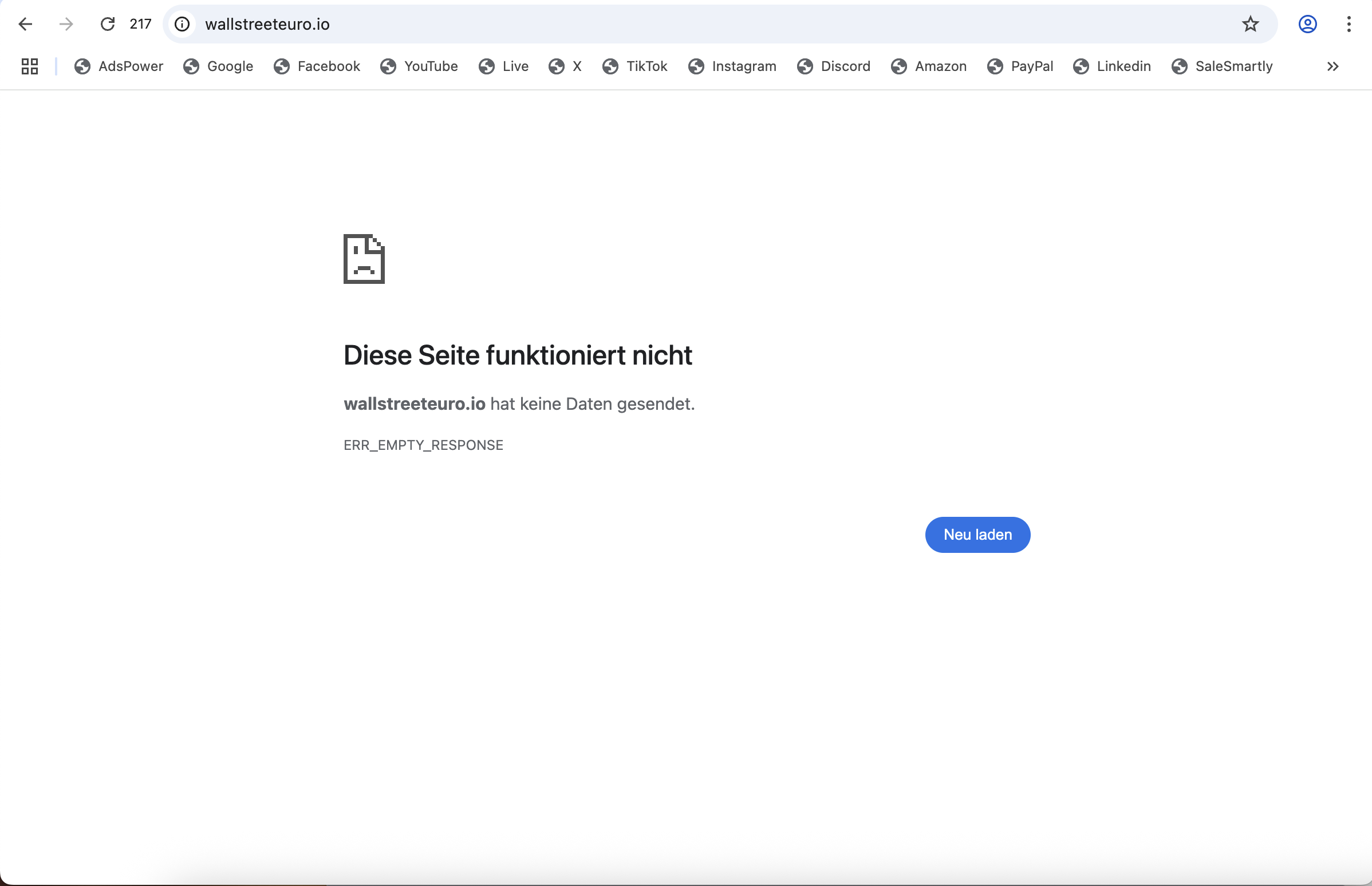
Short-lived domains, privacy-shielded ownership records, and frequent infrastructure changes are hallmarks of platforms that do not intend to operate long-term.
While these tactics are not illegal on their own, they are strategically useful for entities seeking to avoid accountability. WallStreetEuro.io shows multiple signs consistent with this operational philosophy.
Long-term financial services build permanence. High-risk platforms build exits.
Fact 9: The Risk Profile Is Asymmetrical
Perhaps the most important point is this: the risk distribution surrounding WallStreetEuro.io is unbalanced.
-
The platform carries little visible downside
-
The investor carries nearly all of it
There is no clear legal fallback, no regulator-mediated recovery path, and no transparency that would allow informed consent. This asymmetry alone makes participation irrational from a risk-management perspective.
Why This Matters Beyond One Platform
WallStreetEuro.io is not unique—it is representative.
Hundreds of similar platforms appear each year, leveraging identical structures, language patterns, and psychological triggers. They thrive not because investors are careless, but because modern scams are designed to feel indistinguishable from legitimate services.
Recognizing this pattern early is the difference between avoidance and loss.
Investor Self-Protection Checklist
Before engaging with any trading platform:
-
Verify regulation directly with the regulator’s database
-
Confirm company ownership through official registries
-
Test withdrawals early and cautiously
-
Reject guaranteed or “managed” outcomes
-
Avoid urgency-driven investment pressure
If a platform resists scrutiny, scrutiny is exactly what it cannot survive.
Final Assessment
WallStreetEuro.io presents itself as a functional trading service, but fails the fundamental tests of transparency, accountability, and verifiability. Its operational design, regulatory gaps, and user-risk exposure place it firmly in the category of platforms investors should avoid.
Caution here is not pessimism—it is rational defense.
If You’ve Already Been Affected
If you have suffered losses involving WallStreetEuro.io, swift action matters. Independent recovery advisory services such as bridgereclaim.com assist victims in documenting cases, avoiding secondary scams, and understanding realistic recovery options.
Delay only reduces available pathways.
Closing Perspective
In digital finance, appearance is cheap. Accountability is rare.
WallStreetEuro.io offers the former without the latter—and that imbalance is all investors need to know.
Learn more: Scam Awareness | Scam Alerts | Book Consultation | What To Do After Being Scammed | Common Scam Types | Red Flags & Warning Signs