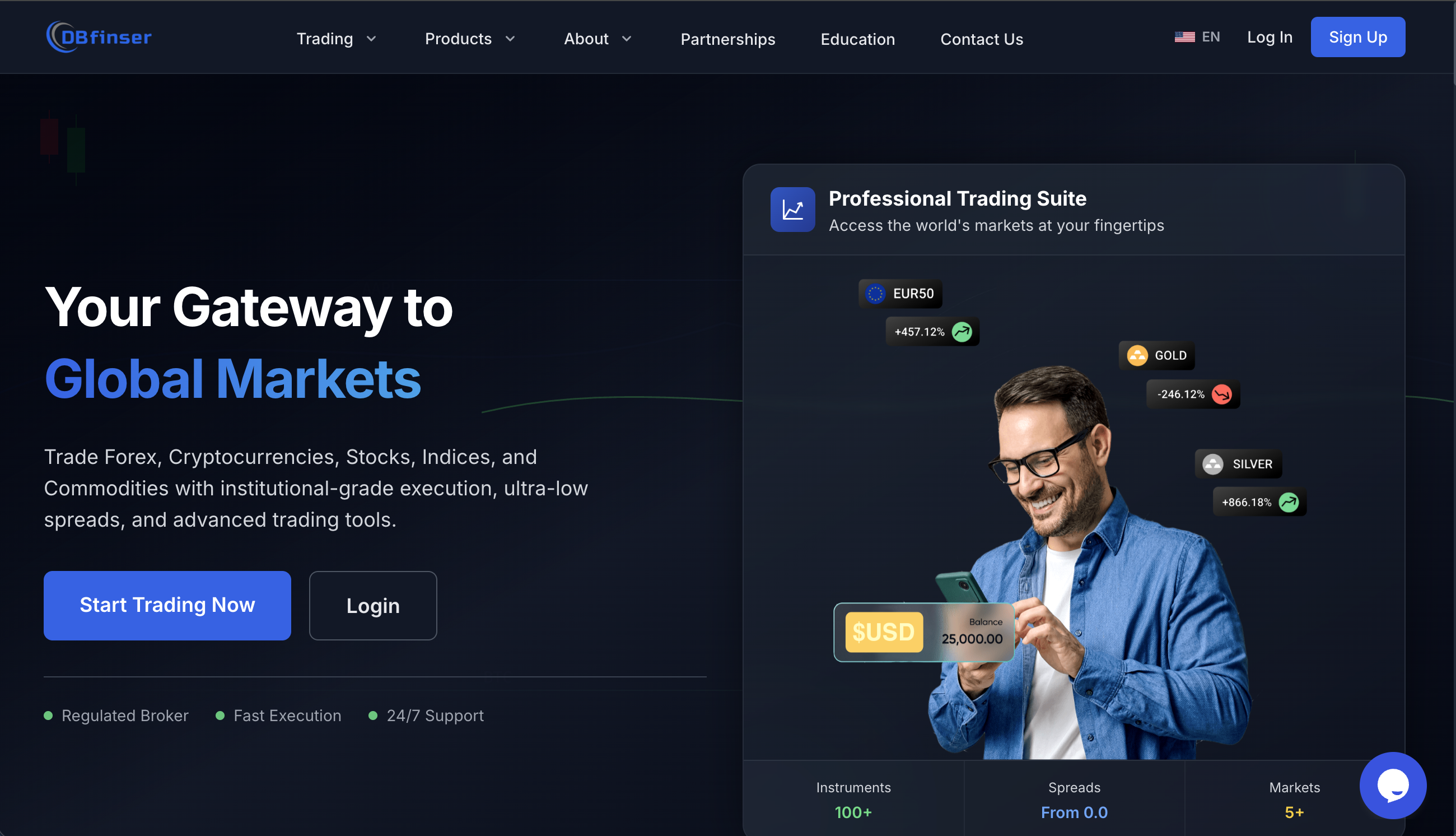
DBFinser Review: A Closer Look at Operations
Online trading platforms continue to emerge at a rapid pace, often presenting themselves as sophisticated financial institutions capable of delivering access to global markets. Among these newer entrants is DBFinser.com, a platform advertising forex, cryptocurrency, stocks, commodities, and CFD trading opportunities.
This review examines DBFinser.com from the perspective of a fraud investigator. Rather than relying on marketing claims or isolated testimonials, the focus here is on documented evidence, timeline reconstruction, regulatory findings, operational characteristics, and identifiable risk indicators.
The objective is not to determine guilt through speculation, but to evaluate whether the available evidence supports confidence in the platform’s legitimacy.
General Overview
DBFinser presents itself as a multi-asset brokerage offering advanced trading technology, institutional-grade execution, copy trading capabilities, AI-powered bots, and yield programs. The website promotes professional trading conditions, fast withdrawals, and regulatory oversight.
On the surface, these characteristics resemble those used by established brokers. However, a closer investigation reveals several inconsistencies that warrant careful examination.
The most significant concern involves regulatory representation. Financial firms operating legitimately typically provide transparent licensing information that can be independently verified through official databases. Investigators reviewing DBFinser encounter discrepancies between the platform’s claims and publicly available regulatory information.
These inconsistencies form the foundation of a broader risk assessment.
Timeline Reconstruction
January 2026: Domain Registration
Publicly available domain information indicates that dbfinser.com was registered on January 18, 2026.
In isolation, a newly registered domain does not automatically indicate fraudulent intent. Every legitimate business begins somewhere. However, the age of a domain becomes highly relevant when a platform simultaneously portrays itself as an established international brokerage with sophisticated infrastructure and extensive global operations.
Investigators frequently view the combination of “newly registered website” and “claims of extensive industry experience” as a warning signal requiring deeper scrutiny.
Early Operational Phase
Following registration, DBFinser rapidly expanded its online presence through promotional content emphasizing:
- Access to multiple financial markets;
- Copy trading functionality;
- Artificial intelligence trading systems;
- Yield-generating investment opportunities;
- High leverage products.
These offerings collectively target a broad audience ranging from beginners to experienced traders.
However, evidence supporting the operational maturity required to deliver these services remains limited.
March 2026: Regulatory Attention
One of the most significant developments occurred when the Australian Securities and Investments Commission (ASIC) reportedly identified dbfinser.com as part of an investor alert involving impersonation concerns associated with Personal Financial Services Ltd.
Independent reporting sources subsequently referenced this warning when discussing DBFinser’s operational status. Multiple reviews characterized the platform as a potential clone operation utilizing misleading regulatory representations.
For investigators, regulatory alerts carry substantial evidentiary weight because they originate from agencies responsible for protecting consumers within financial markets.
Regulatory Findings
Regulatory verification represents one of the most critical stages in any fraud investigation involving investment platforms.
DBFinser’s website has advertised associations with regulatory authorities, including the Central Bank of Ireland and ASIC-related entities.
However, independent reviews have questioned whether those regulatory references accurately correspond to the services being promoted.
Several concerns emerge.
Mismatch Between Claimed Services and Regulatory Scope
The platform advertises CFD trading, leveraged products, and broad investment opportunities.
Investigative reviews have suggested that entities cited by DBFinser may not possess authorization covering the full range of activities promoted on the website. This distinction is essential.
Financial authorization is not universal.
A company licensed to perform one category of activity cannot automatically conduct all forms of investment business.
If a platform presents regulatory credentials beyond their approved scope, investors may incorrectly assume protections exist when they do not.
Clone Firm Allegations
Another concerning development involves reports describing DBFinser as a possible clone firm.
Clone firms attempt to gain credibility by mimicking legitimate organizations through similar names, license references, or misleading associations.
According to publicly discussed findings, ASIC’s investor alerts highlighted impersonation concerns connected to dbfinser.com.
For investigators, clone-firm indicators significantly elevate overall risk assessments because they suggest deliberate efforts to leverage the reputation of unrelated authorized businesses.
Platform Operations
Understanding how a platform operates provides insight into whether its business model aligns with industry norms.
DBFinser advertises numerous features designed to attract investors.
These include:
Multi-Asset Trading
The platform claims to provide access to:
- Forex markets;
- Cryptocurrencies;
- Commodities;
- Stock CFDs;
- Indices.
While diversified offerings are common among brokers, investigators look beyond the product list to evaluate execution transparency.
Questions include:
- Who provides liquidity?
- Which technology vendors support execution?
- Are independent audits available?
- Is pricing methodology disclosed?
Publicly available information provides limited answers to these questions.
Copy Trading Services
DBFinser promotes strategy providers whose trades can allegedly be replicated automatically.
Copy trading itself is not inherently problematic.
However, investigators expect transparency regarding:
- Historical performance verification;
- Risk disclosures;
- Provider selection standards;
- Independent performance auditing.
Without such evidence, prospective users may struggle to evaluate whether advertised results reflect genuine market activity.
AI Trading Bots
The website also references artificial intelligence trading systems.
AI terminology has become increasingly common within questionable investment schemes because it conveys sophistication while remaining difficult for consumers to assess.
Investigators typically ask:
- Who developed the algorithms?
- What testing methodologies were used?
- Are performance records independently verified?
If these questions remain unanswered, promotional language alone should not be considered evidence of effectiveness.
Evidence-Based Risk Indicators
No single factor definitively establishes fraudulent intent.
Instead, investigators evaluate patterns.
DBFinser exhibits several characteristics commonly associated with elevated investment risk.
Recent Domain Registration
The platform’s relatively new domain history contrasts with branding that implies substantial operational experience.
This discrepancy warrants caution.
Regulatory Ambiguity
Questions surrounding licensing status and allegations involving regulatory impersonation represent major concerns.
When investors cannot independently confirm authorization, risk increases significantly.
Limited Corporate Transparency
Investigators prioritize verifiable information regarding:
- Ownership;
- Executive leadership;
- Physical headquarters;
- Corporate registration details.
Limited disclosure reduces accountability.
Broad Product Expansion
Offering forex, crypto, stocks, AI bots, yield programs, and copy trading simultaneously requires extensive compliance infrastructure.
Rapid expansion across multiple high-risk sectors can sometimes indicate marketing priorities outweigh operational maturity.
Promotional Complexity
Fraud investigations frequently uncover platforms relying on sophisticated narratives rather than transparent documentation.
Terms such as “institutional-grade execution” and “advanced intelligence” may sound reassuring but require supporting evidence.
Without independent verification, these statements remain marketing claims.
User Experience Considerations
Consumer reports involving emerging trading platforms often follow recognizable patterns.
Initially, users describe professional onboarding experiences characterized by attentive communication and encouragement to deposit funds.
Difficulties may emerge later during withdrawal requests, verification processes, or attempts to obtain detailed explanations regarding trading activity.
While individual complaints should never be treated as conclusive proof, recurring themes deserve attention.
Investigators encourage consumers to document all interactions, including:
- Email correspondence;
- Account statements;
- Transaction records;
- Chat communications;
- Promotional promises.
These records become essential should disputes arise.
Lessons for Potential Investors
DBFinser’s case illustrates broader principles applicable to any online investment opportunity.
Before depositing funds, consumers should independently verify:
- Regulatory authorization through official databases.
- Corporate registration information.
- Domain history and business longevity.
- Availability of clear legal documentation.
- Transparency regarding fees and withdrawal procedures.
- The existence of credible third-party audits.
Importantly, investors should avoid relying exclusively on testimonials published directly on a company’s website.
Independent verification remains indispensable.
Final Assessment
Based on the evidence currently available, DBFinser raises several concerns that merit serious consideration.
The platform operates through a relatively new domain while presenting itself as an established global brokerage. Public discussions referencing regulatory warnings and clone-firm allegations further complicate its credibility profile.
Additionally, questions surrounding licensing scope, operational transparency, and the verification of advertised services contribute to an elevated risk assessment.
This review does not constitute a legal determination that DBFinser is definitively fraudulent. Such conclusions ultimately fall within the authority of courts and regulatory bodies.
However, from an investigative standpoint, the combination of documented warning signs suggests that prospective investors should exercise extreme caution.
Financial fraud often succeeds because professional presentation creates an illusion of legitimacy. Effective due diligence requires looking beyond polished websites and ambitious promises.
Until DBFinser can provide clear, independently verifiable evidence addressing the concerns identified above, investors would be prudent to approach the platform with skepticism and prioritize regulated alternatives with established track records.
In financial investigations, uncertainty itself is a risk factor. When substantial questions remain unanswered, preserving capital should take precedence over pursuing opportunity.
-
Contact Bridgereclaim.com to Review Your Case
If you have lost money to dbfinser.com, it is important to act without delay. You can submit details of your experience to BRIDGERECLAIM.COM, a platform that assists individuals who have been affected by fraudulent online trading activity. Taking prompt action may improve the likelihood of addressing the situation and pursuing accountability for those responsible.
Unregulated brokers such as dbfinser.com continue to target unsuspecting investors. Staying informed, avoiding platforms that lack proper oversight, and alerting the appropriate channels can help protect both yourself and others from financial misconduct.