Noxirise Review: Can Investors Verify Its Claims?
Introduction
When assessing any online investment platform, the most important question is not whether the website appears professional or offers attractive opportunities. Instead, investors should ask whether the business demonstrates the level of transparency, regulatory oversight, and operational accountability expected within the financial services industry.
Noxirise.com presents itself as a sophisticated trading platform offering access to multiple asset classes, including forex, commodities, and cryptocurrencies. Marketing language associated with the platform emphasizes institutional-grade services, advanced technology, and enhanced trading conditions.
However, compliance analysis extends beyond promotional claims. It examines whether a firm provides verifiable information about its ownership structure, regulatory standing, operational jurisdiction, and safeguards designed to protect investors.
Based on publicly available information, Noxirise raises several concerns that warrant careful consideration before any funds are deposited.
Due Diligence: Looking Beyond Marketing Claims
Effective due diligence involves independently verifying the representations made by an investment platform.
Potential investors should evaluate several key factors:
- Who owns the company?
- Where is the business incorporated?
- Which regulatory authority supervises its activities?
- Can licensing claims be independently confirmed?
- Are customer protection measures clearly documented?
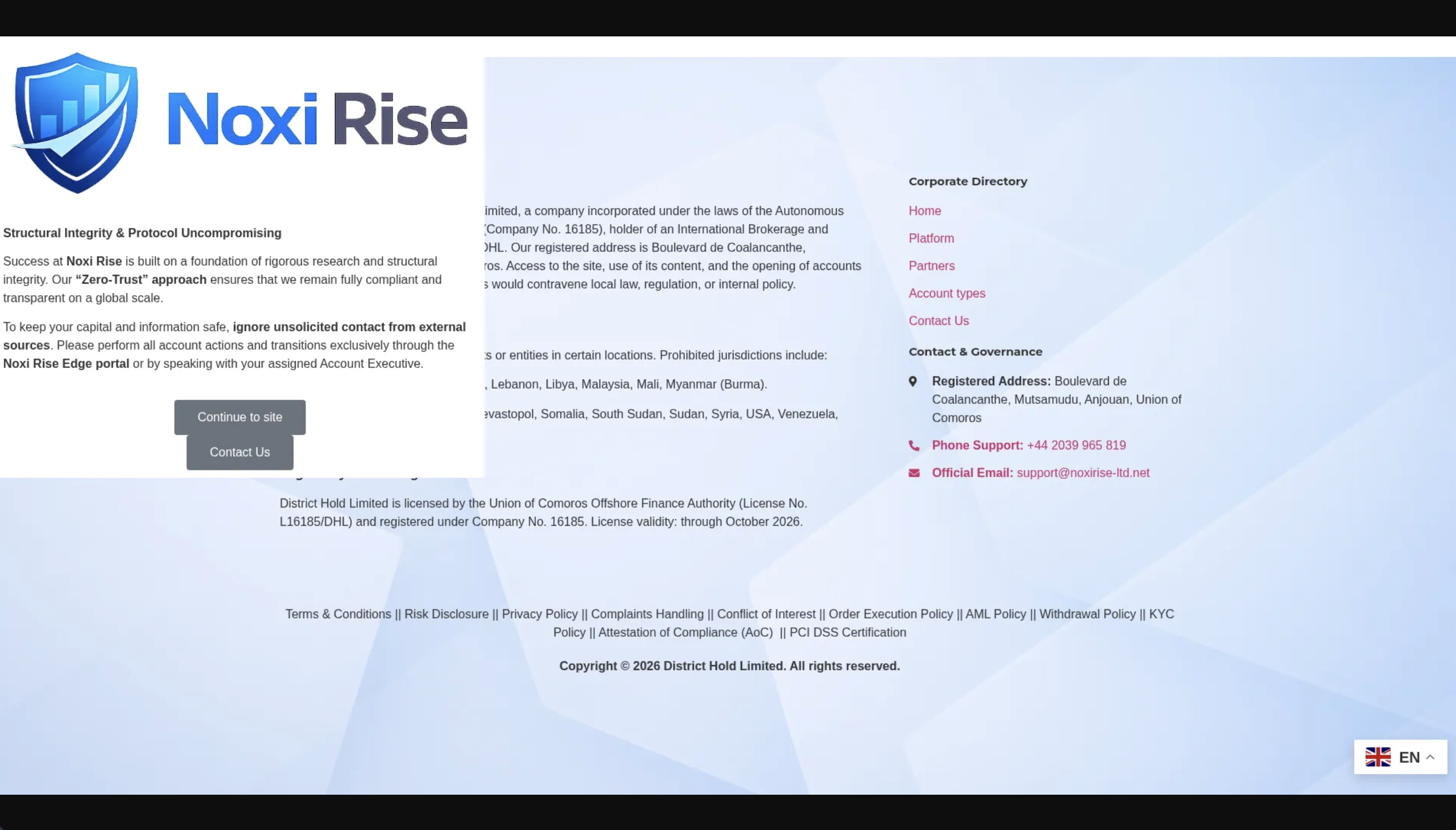
In the case of Noxirise, obtaining clear answers to these questions appears challenging.
Independent assessments have noted that the domain associated with the platform is relatively new and that ownership information is concealed through privacy services.
While privacy protection alone does not automatically indicate fraudulent activity, it creates difficulties for investors attempting to establish accountability. Legitimate financial institutions generally provide detailed corporate information precisely because transparency enhances credibility.
A lack of accessible ownership information complicates the due diligence process and limits investors’ ability to identify the individuals ultimately responsible for managing client assets.
Transparency Concerns
Transparency represents one of the fundamental pillars of investor confidence.
Regulated financial institutions typically disclose:
- Registered company names;
- Corporate registration numbers;
- Physical business addresses;
- Executive leadership information;
- Regulatory licenses;
- Complaint procedures;
- Investor compensation arrangements.
When reviewing Noxirise, observers may struggle to locate independently verifiable disclosures that meet these standards.
Scamadviser’s analysis highlighted the use of hidden WHOIS registration information and noted concerns regarding the website’s limited operational history. According to the report, the domain registration details are masked and the website itself is relatively new.
Transparency gaps do not automatically prove wrongdoing. However, from a compliance perspective, they increase uncertainty.
Financial service providers asking consumers to commit capital should be prepared to provide extensive documentation supporting their legitimacy.
When such documentation is difficult to verify independently, caution becomes appropriate.
Regulation and Licensing Considerations
Regulatory oversight exists to reduce the likelihood of misconduct and to establish standards for handling client funds.
Depending on the jurisdiction, regulated investment firms may be required to:
- Maintain minimum capital reserves;
- Segregate client funds;
- Conduct identity verification procedures;
- Submit periodic audits;
- Maintain complaint resolution systems;
- Participate in compensation schemes.
Before opening an account with any investment platform, investors should independently verify licensing information directly through the relevant regulatory authority.
A compliance review should seek evidence demonstrating:
- The name of the supervising regulator;
- The applicable license number;
- The regulated entity’s legal name;
- Confirmation that the regulator recognizes the firm.
In situations where regulatory disclosures cannot be independently validated, investors may face elevated risks.
These risks include limited recourse in the event of disputes involving withdrawals, account restrictions, or allegations of misrepresentation.
The absence of clear regulatory accountability often leaves affected individuals navigating complex cross-border issues without the protections typically associated with regulated financial markets.
Ownership and Corporate Accountability
Ownership disclosure is another critical component of compliance evaluation.
When investors cannot identify who controls an organization, questions naturally emerge regarding accountability.
Independent analyses have indicated that Noxirise’s ownership details are shielded through privacy services.
Again, this factor alone should not be interpreted as definitive evidence of malicious intent. Some businesses legitimately choose privacy measures for operational reasons.
However, within the financial sector, higher transparency standards are generally expected because firms are entrusted with customer funds.
Corporate accountability allows investors to:
- Research management backgrounds;
- Review prior business conduct;
- Assess litigation histories;
- Verify professional qualifications;
- Understand organizational structures.
Without such information, meaningful due diligence becomes significantly more difficult.
Investor Protection Considerations
One of the most important questions prospective users should ask is:
“What protections exist if something goes wrong?”
Investor protection mechanisms vary considerably between regulated and unregulated environments.
Possible safeguards may include:
- Segregated client accounts;
- Negative balance protection;
- Independent dispute resolution bodies;
- Compensation programs;
- Mandatory audit requirements.
Marketing materials sometimes reference these protections. However, compliance analysts emphasize the importance of independent verification.
Consumers should avoid assuming that advertised safeguards automatically carry regulatory backing.
If a dispute arises involving delayed withdrawals or account limitations, practical enforcement often depends upon whether recognized regulators possess jurisdiction over the platform’s activities.
Absent such oversight, investors may encounter substantial obstacles when seeking remedies.
User Complaints and Public Feedback
Public feedback should never serve as the sole basis for evaluating a financial platform.
Nevertheless, recurring themes within customer experiences may provide useful context during due diligence exercises.
Recent reviews published on independent review platforms describe concerns involving persistent communications following registration and pressure associated with funding requests.
These accounts represent individual experiences and should not be interpreted as definitive proof of misconduct.
However, compliance professionals often examine complaint patterns to identify potential indicators requiring further investigation.
Warning signs may include:
- Aggressive sales tactics;
- Pressure to deposit quickly;
- Resistance toward withdrawal requests;
- Inconsistent explanations regarding fees;
- Difficulty obtaining responsive customer support.
Where multiple complaints reference similar experiences, additional scrutiny becomes advisable.
Risk Indicators Identified Through Independent Analysis
Third-party website evaluators have assigned low trust assessments to Noxirise.
Scamadviser reported concerns relating to the website’s recent registration, hidden ownership details, and associations with high-risk financial activities.
Similarly, Scam Detector assigned a low trust score while identifying multiple factors contributing to elevated risk assessments.
Gridinsoft categorized the website as suspicious, citing several trust-related indicators, including limited independent reputation data and concealed ownership information.
Importantly, automated trust-scoring systems are not infallible.
Their findings should be viewed as prompts for further investigation rather than definitive judgments.
However, when multiple independent evaluators highlight comparable concerns, prudent investors should carefully reassess their exposure.
Practical Due Diligence Steps for Investors
Anyone considering engagement with an online trading platform should undertake the following actions:
- Verify licensing directly through official regulatory databases.
- Confirm the company’s legal registration information.
- Research corporate leadership backgrounds.
- Review independent customer feedback from multiple sources.
- Test customer support responsiveness before depositing funds.
- Carefully examine withdrawal policies and fee schedules.
- Avoid transferring money under pressure.
- Maintain comprehensive records of all communications and transactions.
- Start with minimal exposure if proceeding despite reservations.
- Seek independent financial advice before committing substantial capital.
Due diligence cannot eliminate all investment risk, but it can reduce vulnerability to preventable losses.
Final Assessment
From a compliance analyst’s perspective, Noxirise presents several issues that deserve serious consideration.
Transparency limitations relating to ownership disclosure, questions surrounding independently verifiable regulatory oversight, and the existence of negative trust assessments collectively suggest that enhanced caution is appropriate.
None of these observations independently establishes intentional wrongdoing.
However, effective investor protection depends upon informed decision-making supported by independently verified facts rather than marketing representations alone.
Before depositing funds with any online investment platform, consumers should ensure they fully understand who operates the business, under whose authority it functions, and what practical remedies exist should problems arise.
In an increasingly complex digital investment landscape, skepticism is not pessimism—it is an essential component of responsible due diligence.
Where transparency is limited and accountability remains unclear, the wisest course of action may be to postpone investment decisions until satisfactory evidence addressing those concerns becomes available.
-
Contact Bridgereclaim.com to Review Your Case
If you have lost money to noxirise.com, it is important to act without delay. You can submit details of your experience to BRIDGERECLAIM.COM, a platform that assists individuals who have been affected by fraudulent online trading activity. Taking prompt action may improve the likelihood of addressing the situation and pursuing accountability for those responsible.
Unregulated brokers such as noxirise.com continue to target unsuspecting investors. Staying informed, avoiding platforms that lack proper oversight, and alerting the appropriate channels can help protect both yourself and others from financial misconduct.