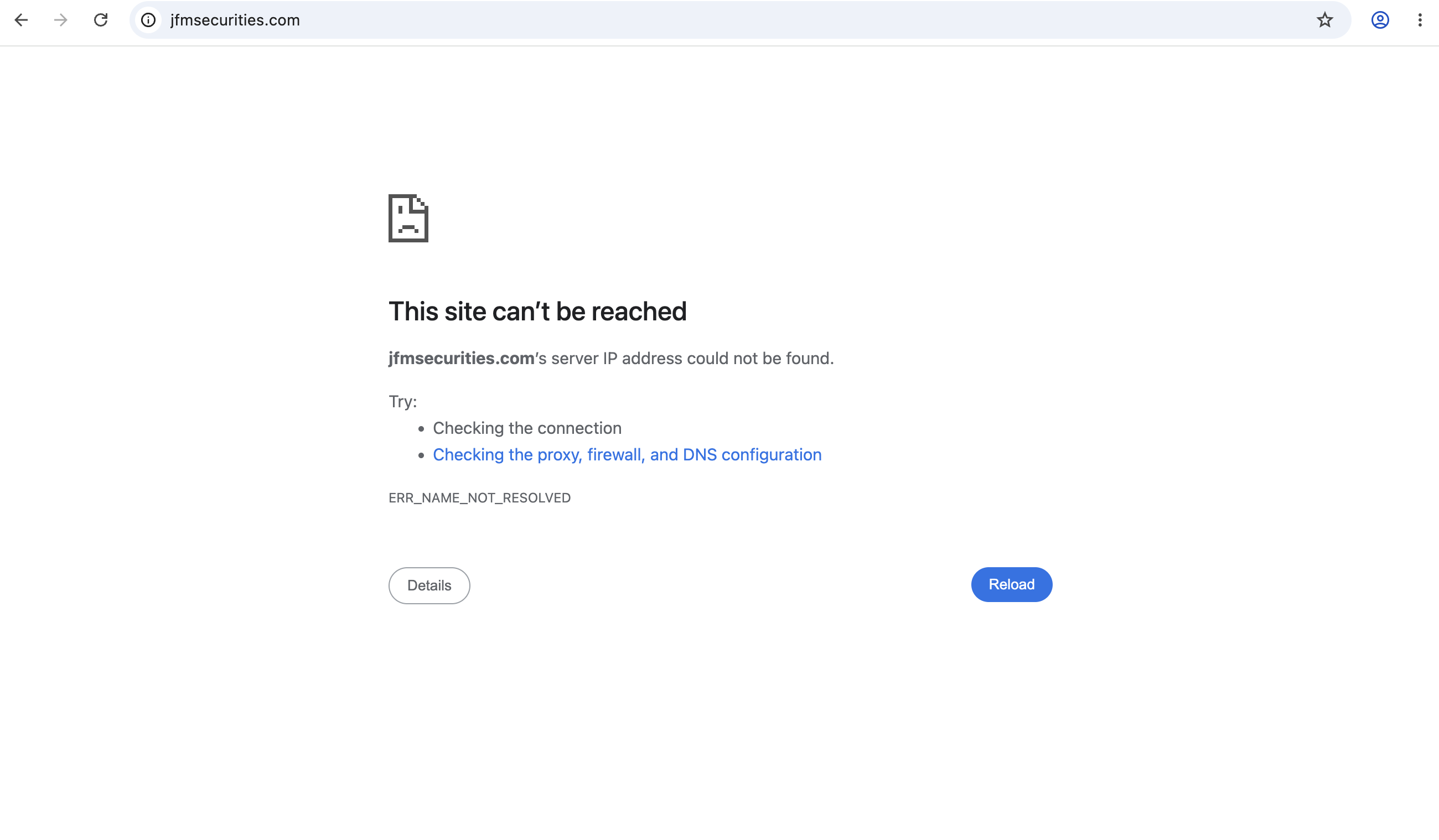
jfmsecurities.com Evidence Based Analysis 2026
1. Executive Summary of Findings
The domain jfmsecurities.com presents itself as a wealth management and investment platform offering access to stocks, pre-IPO opportunities, and managed funds. On the surface, it mimics the structure and language of a legitimate brokerage or investment advisory firm. However, multiple independent risk assessments, cybersecurity analyses, and regulatory alerts indicate that the platform displays characteristics consistent with impersonation-based investment fraud infrastructure.
Across aggregated threat intelligence sources, the platform has been assigned a low trust rating, with warning signals tied to domain age, hosting patterns, and financial-services impersonation risk. One analysis classifies it as “questionable” with a trust score of approximately 36.2/100, indicating elevated probability of deceptive or unregulated activity rather than legitimate brokerage operations.
Most critically, external reporting links this domain to a broader pattern of impersonation of legitimate Australian financial entities, a known tactic in high-yield investment fraud ecosystems.
2. Platform Claims vs. Observed Infrastructure
Claimed Identity
The website presents itself as:
- A wealth management firm
- Based in Melbourne, Australia
- Offering:
- Stock investments
- Pre-IPO opportunities
- Managed funds
- Promising:
- Diversification
- Liquidity
- Long-term growth
This branding is strategically aligned with legitimate financial advisory language, designed to build investor confidence quickly.
Observed Infrastructure Red Flags
Investigative technical analysis reveals inconsistencies:
- Domain age is very recent (2025 registration)
Fraudulent investment platforms frequently operate within short lifecycle windows before disappearing or rebranding. - Ownership data is fully hidden (WHOIS redaction)
Legitimate regulated financial institutions rarely obscure corporate identity details. - Hosting infrastructure is shared with other flagged domains
The domain is hosted alongside multiple websites categorized as suspicious or high-risk. - SSL exists but is basic (DV certificate)
A valid SSL certificate does not indicate legitimacy; it only confirms encrypted traffic, not business identity.
These technical signals align with known patterns of low-cost fraud deployment infrastructure rather than regulated financial services architecture.
3. Timeline Reconstruction of Domain Activity
Based on registry and external monitoring data:
Phase 1 – Domain Registration (March 2025)
The domain was registered on March 27, 2025, under a privacy-protected WHOIS structure. This marks the operational starting point of the platform.
Phase 2 – Rapid Deployment (Mid–2025)
Shortly after registration:
- Website becomes active with full “investment platform” branding
- Claims of institutional-grade investment offerings appear
- Marketing material begins targeting retail investors
This rapid deployment phase is typical of “ready-made brokerage scam kits”, where infrastructure is prebuilt and rebranded quickly.
Phase 3 – Visibility Expansion (Late 2025)
The platform begins appearing in:
- Online ads
- Investment outreach campaigns
- Social media promotional funnels
During this stage, multiple cybersecurity rating engines flag the domain as suspicious due to:
- Low traffic ranking
- Shared hosting anomalies
- Association with other flagged domains
Phase 4 – Regulatory Attention (Early 2026)
External reporting indicates escalation:
- Reports emerge linking the domain to impersonation of a legitimate Australian financial entity (JFM Pty Ltd)
- Investor complaints begin surfacing
- Loss cases associated with high-value deposits (tens of thousands of dollars) are documented
This phase reflects a transition from passive website operation to active victim acquisition stage, where financial harm begins to materialize.
4. Regulatory and Compliance Findings
4.1 Impersonation Warning Pattern
The most significant regulatory signal is the alleged impersonation of a legitimate firm.
According to investigative reporting, the domain has been linked to an entity impersonating an Australian-registered company, which has triggered investor alerts from financial oversight bodies in Australia.
Impersonation scams typically involve:
- Copying legitimate company branding
- Creating near-identical domain names
- Claiming false regulatory status
- Redirecting victims into fake trading dashboards
This is one of the highest-risk categories in investment fraud typologies.
4.2 Absence of Verified Licensing
No evidence indicates:
- Registration with Australian Securities & Investments Commission (ASIC)
- Registration with Canadian provincial securities regulators
- FCA (UK) authorization
- SEC/FINRA oversight
In regulated markets, entities offering:
- securities trading
- pre-IPO investments
- managed funds
must be registered and publicly verifiable. The absence of such data is a major compliance violation indicator.
4.3 High-Risk Financial Service Classification
Independent scoring systems classify the platform as:
- High-risk financial service
- Potential phishing infrastructure
- Possible investment fraud channel
These classifications are based on:
- Domain behavior
- Hosting proximity to suspicious servers
- Spam/phishing signal detection
- Industry mismatch indicators
5. Operational Model Analysis
Based on observed patterns, the platform likely operates under a multi-stage fraud funnel model.
Stage 1: Acquisition
Victims are attracted via:
- Social media ads
- Cold outreach messages
- Investment “consultant” impersonation
- Fake performance screenshots
Stage 2: Trust Building
Users are directed to:
- Professionally designed dashboards
- Fake portfolio performance charts
- “Account managers” posing as advisors
The goal is psychological normalization of deposits.
Stage 3: Capital Injection
Victims are encouraged to:
- Start with small deposits
- Upgrade to “premium investment tiers”
- Invest in “exclusive pre-IPO deals”
This stage escalates financial exposure.
Stage 4: Extraction
Common outcomes include:
- Withdrawal restrictions (“tax fees,” “verification delays”)
- Requests for additional deposits to “unlock funds”
- Sudden account freezing
- Platform disappearance or communication breakdown
This structure is consistent with advance-fee investment fraud architectures.
6. Risk Indicators Identified
6.1 Technical Risk Indicators
- Very recent domain creation
- Hidden ownership details
- Shared server with flagged domains
- Low global traffic ranking
6.2 Behavioral Risk Indicators
- Unrealistic investment offerings (pre-IPO access for retail users)
- Guaranteed or high-return language
- Pressure-based investment escalation
- Lack of verifiable regulatory disclosure
6.3 Structural Risk Indicators
- Lack of independent audits
- No verifiable leadership team
- No transparent corporate filings
- No publicly verifiable brokerage license
6.4 Psychological Manipulation Indicators
- Use of institutional terminology (“wealth management,” “liquidity optimization”)
- Creation of urgency around investment opportunities
- Fabricated exclusivity (“limited access funds”)
7. Victimology Patterns (Observed Cases)
Documented cases associated with similar platforms show consistent victim profiles:
- Individuals seeking passive income opportunities
- First-time investors in crypto or equities
- Victims approached via social media investment groups
- Users transitioning from demo gains to real deposits
One documented case associated with this ecosystem describes losses exceeding $60,000+ USD, triggered by gradual trust-building and staged investment escalation before withdrawal restrictions were imposed.
8. Comparative Fraud Pattern Analysis
The structure of jfmsecurities.com closely resembles:
- Clone brokerage scams
- Impersonation investment firms
- Crypto-to-fiat hybrid fraud platforms
- Offshore unregulated “wealth managers”
Common across all models:
- Short domain lifecycle
- High-return promises
- Withdrawal obstruction
- Regulatory invisibility
This places the platform in a high-confidence fraud pattern cluster.
9. Final Assessment
Based on aggregated evidence, jfmsecurities.com exhibits:
- Strong impersonation indicators
- Lack of regulatory legitimacy
- High-risk hosting and infrastructure patterns
- Behavioral alignment with known investment fraud models
- External reporting linking it to confirmed impersonation warnings
Investigator Conclusion
While no single technical indicator alone proves fraud, the convergence of multiple independent red flags creates a coherent risk profile consistent with:
A high-risk, likely unregulated investment platform operating within an impersonation-based fraud ecosystem.
Users interacting with this platform should assume:
- Funds may not be recoverable once deposited
- Withdrawal mechanisms may be artificially restricted
- Communication channels may be temporary or controlled
10. Preventive Recommendations
From a fraud prevention standpoint:
- Always verify brokerage registration via official regulators (ASIC, FCA, SEC)
- Cross-check domain names against legitimate company websites
- Avoid investment platforms guaranteeing returns or private opportunities
- Treat “wealth manager” outreach via social media as high-risk by default
- Never increase deposits to unlock withdrawals
-
Contact Bridgereclaim.com to Review Your Case
If you have lost money to jfmsecurities.com, it is important to act without delay. You can submit details of your experience to BRIDGERECLAIM.COM, a platform that assists individuals who have been affected by fraudulent online trading activity. Taking prompt action may improve the likelihood of addressing the situation and pursuing accountability for those responsible.
Unregulated brokers such as jfmsecurities.com continue to target unsuspecting investors. Staying informed, avoiding platforms that lack proper oversight, and alerting the appropriate channels can help protect both yourself and others from financial misconduct.