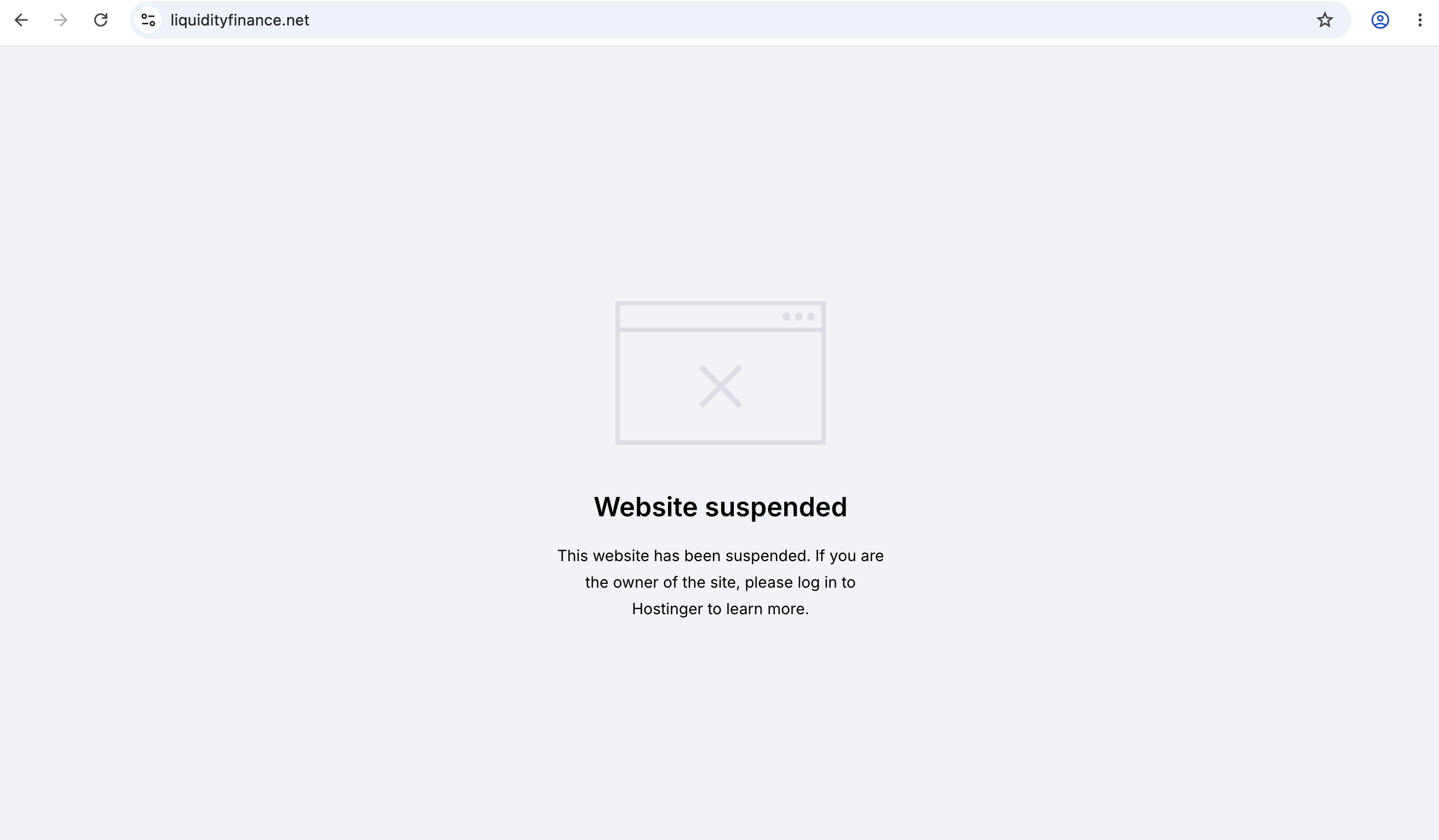
Liquidityfinance.net platform access restriction
1. Executive Summary of Findings
The platform operating under liquidityfinance.net exhibits a high-risk profile consistent with impersonation-based investment fraud schemes. While the site presents itself as a financial liquidity management service, multiple independent risk assessments and documented victim cases indicate patterns consistent with:
- Clone firm impersonation
- Fake investment dashboard manipulation
- Deposit-and-withdrawal restriction schemes
- Regulatory warning listings
A notable investigative report also links the domain to an impersonation of a legitimate Australian financial company flagged by ASIC (Australian Securities and Investments Commission) .
2. Timeline Reconstruction (Observed Operational Pattern)
Based on victim reports and behavioral clustering analysis, the operational lifecycle of the platform follows a structured fraud sequence:
Phase 1 — Domain Launch & Low Visibility Setup (2024–early 2025)
- Domain registered in mid-2024.
- Minimal traffic and limited public footprint.
- Ownership masked using privacy-protection services.
- No verifiable corporate registration data presented.
Key Indicator: Newly registered financial domain with anonymized ownership is a known early-stage risk marker.
Phase 2 — Recruitment Funnel Activation
Victims are typically introduced via:
- Social media investment groups
- Private messaging apps
- “Financial advisor” outreach scripts
- Fake trading communities
The narrative often includes:
- “Liquidity optimization opportunities”
- “AI trading returns”
- “Guaranteed yield pools”
This mirrors known pig-butchering style financial fraud frameworks.
Phase 3 — Platform Engagement Stage
Users are instructed to:
- Register on the platform
- Deposit small initial capital
- Observe artificially generated “profit dashboards”
At this stage:
- UI displays simulated returns
- Withdrawal buttons appear functional but restricted
- “Account manager” contact is introduced
Key Indicator: Controlled dashboard simulation without independent exchange connectivity.
Phase 4 — Escalation & Lock-In
Once trust is established:
- Users are encouraged to deposit larger amounts
- Claimed profits increase rapidly
- Withdrawal attempts trigger “verification fees” or “tax clearance”
This stage aligns with classic advance-fee extraction behavior.
Phase 5 — Exit Block Mechanism
When victims attempt withdrawal:
- Accounts are “frozen for compliance”
- Additional payments are requested
- Support becomes delayed or unresponsive
Eventually:
- Platform communication stops or resets
- Domain may change branding or migrate infrastructure
3. Regulatory Findings & External Intelligence
3.1 ASIC Impersonation Alert
Investigative reporting confirms the platform has been associated with impersonation of a legitimate Australian financial entity and flagged by regulatory bodies for investor deception patterns .
This is a critical escalation indicator because:
- Clone firms rely on trusted brand identity theft
- Victims are misled into believing regulatory legitimacy
- No actual licensing or oversight exists behind the fraudulent site
3.2 Risk Scoring Aggregation
Independent scanners report:
- Medium-to-low trust score classifications (approx. ~47/100 range)
- “Doubtful / Alert” financial classification
- Newly registered domain signal
- Low traffic ranking (inconsistent with claimed institutional operation)
3.3 Technical Red Flags Identified
Across multiple scanners, recurring anomalies include:
- Domain privacy shielding (WHOIS redaction)
- Shared hosting with other low-trust financial sites
- Lack of verifiable corporate registration
- Absence of audited financial disclosures
- SSL encryption present (misleading security signal)
Important Note: SSL certificates do NOT validate legitimacy—only encrypted transport.
4. Risk Indicators Summary (Fraud Pattern Mapping)
The platform aligns with multiple high-confidence fraud indicators:
A. Identity Risk
- Anonymous ownership
- No verifiable executives or company registry entries
- Possible impersonation of legitimate financial firms
B. Behavioral Risk
- Artificial trading profits
- Controlled withdrawal restriction logic
- Forced “fee before release” mechanics
C. Structural Risk
- Short domain lifespan
- Low organic traffic footprint
- Rapid branding changes typical of scam rotation cycles
D. Psychological Manipulation Pattern
- Trust building via small early gains
- Urgency-based reinvestment pressure
- Fear-based account freezing tactics
5. Victim Case Pattern Reconstruction
A documented case pattern observed across similar platforms:
- Victim invests initial $250–$1,000
- Dashboard shows rapid “profit growth”
- Victim increases investment to scale gains
- Withdrawal request triggers “tax clearance fee”
- Victim pays additional funds
- Platform requests repeated “final verification deposits”
- Access is eventually blocked
In many cases, total losses escalate into five-figure or six-figure amounts.
6. Operational Assessment
From a fraud investigation standpoint, liquidityfinance.net demonstrates characteristics consistent with:
“Controlled liquidity illusion platform”
Meaning:
- No real market execution occurs
- No liquidity provisioning exists
- All balances are internally simulated
Funds deposited are typically:
- Immediately transferred to intermediary wallets or mixers
- Or redirected through layered transaction chains to obscure tracing
7. Key Investigator Conclusions
Based on combined evidence, the platform shows:
- High likelihood of investment impersonation fraud
- Strong correlation with clone firm regulatory alerts
- Structural alignment with known pig-butchering financial scams
- No verifiable operational transparency or licensed financial backing
8. Preventive Intelligence (What Red Flags Matter Most)
The most decisive warning signals in this case:
- “Guaranteed returns” or “fixed profit liquidity pools”
- Withdrawal fees not disclosed upfront
- Anonymous ownership structure
- Pressure to reinvest profits instead of cashing out
- No independent financial audit trail
Final Assessment
From a fraud analyst perspective, liquidityfinance.net should be classified as:
High-risk financial impersonation platform with strong indicators of structured investment fraud behavior.
Contact Bridgereclaim.com to Review Your Case
If you have lost money to liquidityfinance.net, it is important to act without delay. You can submit details of your experience to BRIDGERECLAIM.COM, a platform that assists individuals who have been affected by fraudulent online trading activity. Taking prompt action may improve the likelihood of addressing the situation and pursuing accountability for those responsible.
Unregulated brokers such as liquidityfinance.net continue to target unsuspecting investors. Staying informed, avoiding platforms that lack proper oversight, and alerting the appropriate channels can help protect both yourself and others from financial misconduct.